
PRACTICAL LIFE
In the Practical life area, children carry out familiar home
activities such as sweeping, polishing, pouring, preparing
foods, etc. These activities are designed to help the child
achieve independence and confidence through meaningful activities
with real life objects. These activities help develop co –
ordination, concentration, independence, hand dexterity, patience,
grace, courtesy, care of the person and his/her environment.
SENSORIAL
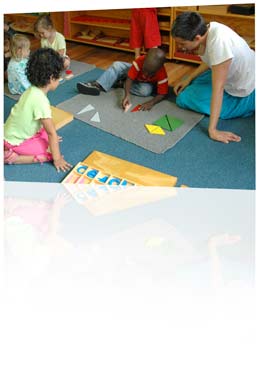
The sensorial apparatus encourages the child to understand
his environment while learning through his senses. Each piece
of didactic material isolates one quality, such as colour,
weight, shape, size, texture, sound, smell, taste, etc., which
enables the child to take in impressions with true understanding
and gives purpose, order and structure to the child’s
learning. Montessori materials all have a control of error,
which allows the child freedom to correct his mistakes unaided.
This auto correction technique develops perseverance and a
positive self – image and attitude towards mistakes.
LANGUAGE
The Montessori method has many activities designed to help
the child progress naturally towards the development of skills
necessary for reading and writing. The child learns to control
wrist movements and perfect the pincer grip necessary for
writing. The child is introduced to reading slowly by first
learning the phonetic sounds of the alphabet, which leads
to building short phonetic words. The child progresses at
his own pace to reading longer phonetic words. Children in
the Montessori environment are introduced to the different
parts of speech and grammar by participating in fun games
with the directress and other children.
MATHEMATICS
The Montessori child is introduced to mathematics in the same
way as all the other subjects, simple to complex and concrete
to abstract. By working with specially designed materials
the child is able work with concrete quantities and then match
abstract symbols. The child is introduced to the various operations
in mathematics in a simple and fun manner. By working with
the concrete materials a solid foundation is formed for later
algebraic and geometric work.
CULTURALS
In the Montessori environment the child is exposed to various
cultural subjects (geography, history, biology, science, music
and art) to feed his/her imagination and understanding of
the world around him/her. By being introduced to different
cultures and life styles, the children’s moral and intellectual
nature is elevated resulting in enlightenment and enjoyment
of each other’s cultures. The cultural activities also
help the child to understand his role in the world and that
he is in fact, a very important part of the whole system.
|
|